The Governance Canvas
The Governance Canvas is a thinking aid for boards and senior leaders.
Used in board-level conversations — not as a framework, checklist or scan.
It does not prescribe governance designs or solutions.
It helps surface
where decision-making sits
when AI runs alongside it —
and where the board itself needs to stay involved.
Why a Governance Canvas?
AI governance questions rarely arise from a single system or incident.
They arise because AI gradually becomes part of decision-making —
often without a conscious discussion
about where board involvement needs to remain.
AI typically enters organisations as a tool,
an efficiency gain or an experiment.
Over time, it begins to shape outcomes.
The Governance Canvas offers a structured way
to bring that shift into the boardroom —
before organisations are asked
who should have stepped in, and why.
The core questions
At the heart of the Governance Canvas are a small number of
deliberately simple — and deliberately uncomfortable — questions:
- Where is AI allowed to run alongside decisions?
- Where does the board need to stay at the controls?
- Who feels responsible for the outcomes?
- Who keeps an eye on things once AI is in use?
- Who can step in when things become tense?
- Who must be able to explain these choices?
If these questions cannot be answered clearly,
there is a good chance that decisions
emerged by default
rather than being consciously made.
The Governance Canvas — visual overview
The diagram below is used in practice
as a conversation surface in board and supervisory board settings.
Not to assess or score,
but to make visible
where responsibility and oversight are
assumed
rather than deliberately discussed.
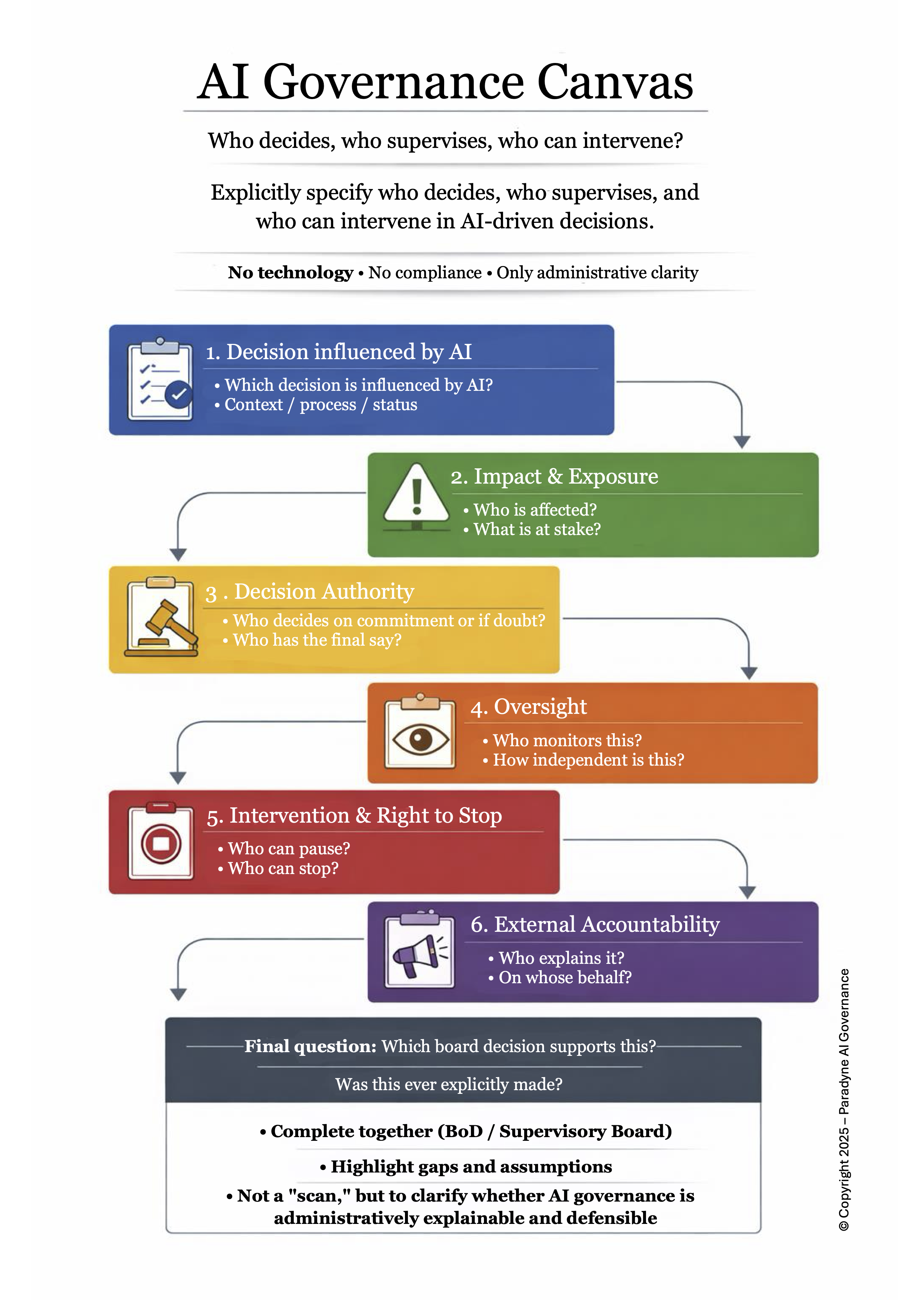
Download the Governance Canvas (A4, printable)
The Canvas is not used to ‘tick boxes’.
It helps surface
which board decision actually sits underneath —
and whether that decision was ever consciously made.
What the Canvas focuses on
- board responsibility rather than formal role descriptions,
- oversight in practice rather than control mechanisms,
- decision authority rather than system or tool ownership.
It complements existing governance,
risk and compliance structures
without replacing or adding to them.
What the Canvas deliberately is not
- not a maturity model,
- not a compliance checklist,
- not a technical or risk assessment,
- not a one-size-fits-all framework.
It does not judge.
It helps boards see where they stand.
How it is used
The Canvas is typically used
in a focused board or senior management conversation.
It is placed on the table — literally or figuratively —
to structure discussion about:
- where AI runs alongside decision-making,
- where board involvement needs to remain,
- and who can step in if necessary.
The value is not in the diagram itself,
but in the recognition
the conversation creates.
Why this matters for boards
AI will make mistakes.
That alone is not a governance failure.
Governance becomes visible
when organisations are asked to explain:
- who should have stepped in, and
- why the judgement at the time was reasonable.
The Governance Canvas helps boards ensure
those answers exist —
before they are needed.
How conversations usually start
Where are we currently letting AI run alongside decisions —
and where should we, as a board, be more hands-on?
From there, the conversation unfolds naturally.
Read how this shows up in practice →
AI governance in practice
The Governance Canvas does not solve problems.
It makes board responsibility visible.